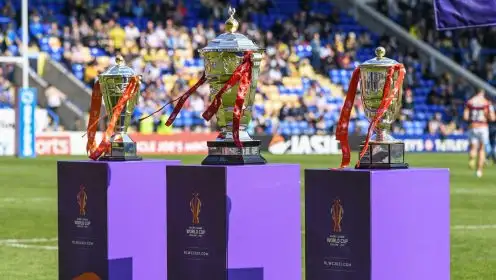
The BBC’s World Cup decision is a consequence of rugby league’s own actions


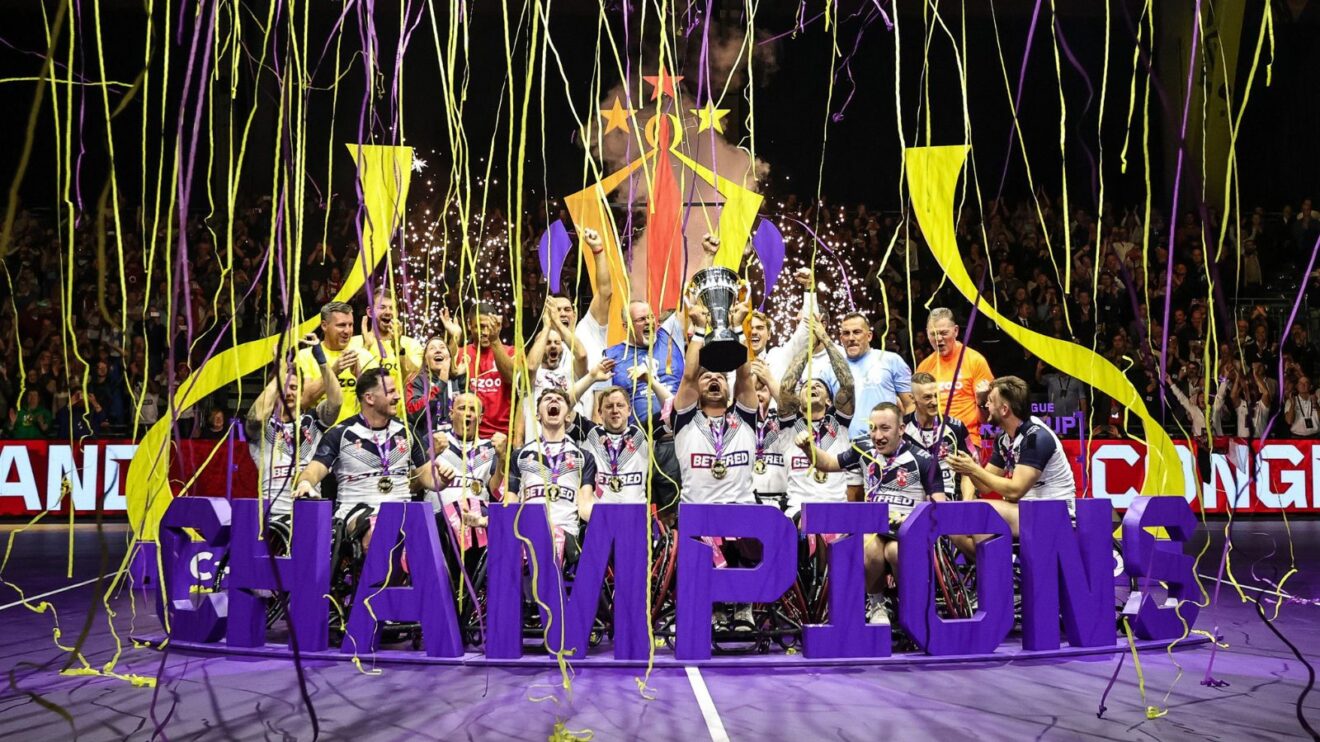
England celebrate their 2021 Wheelchair Rugby League World Cup triumph
October 26, 2014. Reports in Australia emerge suggesting that after the success of the 2013 Rugby League World Cup, the sport is finally going to get its act together and draw up a 12-year international calendar.
We are around two months away from 12 years on since that date – and it is safe to assume those reports did not exactly come to fruition.
No planning, no preparation, no thought given to international rugby league. The sport has always managed to make itself an outlier in that regard; while other sports prioritise their international calendar and major match-ups and tournaments between globally recognised nations, rugby league puts its own international game at the bottom of the rung.
ITV have just paid a reported £90million to show the Rugby World Cup next year. Rugby league can’t even give its own flagship international tournament away – but broadcasters have a right not to be interested if the sport itself isn’t bothered.
So with that in mind, is it any surprise the BBC aren’t interested in showcasing the tournament this autumn?
On one level, it is not a monumental surprise for those who have followed the BBC’s broadcast decisions lately. They opted against showing the recent Commonwealth Games, but delivered a fantastic European Championships in Birmingham to deserved acclaim.
The Beeb also didn’t send an on-site team to the football World Cup until the final week, instead broadcasting it all from their studios in Salford. Money is tight, times are changing – and the Rugby League World Cup is clearly another casualty of this.
But this situation has not been helped in any way, shape or form by rugby league’s own contempt for international games. You only have to look at what power free-to-air TV possesses elsewhere; Amy Hunt is now a household name after winning four golds at the recent European Athletics Championships.
Even if you don’t care about athletics, you will have heard of Amy Hunt and Dina Asher-Smith. That’s what terrestrial television can provide. The World Cup has previously given the England rugby league teams – yes, all three of them – a chance to shine in the spotlight but this autumn as it stands, they will all be tucked away on subscription television.
Many of the points that are worth making have been laboured to death over the last decade. Our own domestic landscape is dominated by clubs filthy with self-interest, with no willingness to trim the domestic calendar even slightly to allow England a chance to be in the spotlight.
In a World Cup year, England will not play a single game of any kind – mid-season, warm-up, Test match – before they kick off in Perth behind a paywall in two months. Now imagine that happening in any other sport. The domestic game in the United Kingdom does not care about England enough: so why should the BBC?
You can point to the fact there is no competition for England on this side of the world, but if the game had decided to actually invest in France and give them meaningful opportunities to compete back in 2014 rather than try and short-change the game there at every opportunity – look at how Catalans and Toulouse are treated by certain quarters of Super League – then perhaps by today, we’d be in a position to have them pushing England.
All of this comes at a time where the BBC’s decision should sharpen the focus of Super League clubs, who will sit around a table on Thursday to discuss potentially the most seismic moment in modern history for the game in the northern hemisphere: the NRL’s deal to invest in Super League.
Wigan CEO Kris Radlinski, one of the game’s real expert voices, was again on the money recently when he insisted while the money is welcome for Super League, what they really need is the NRL’s expertise and credibility in driving the sport forward.
But this too will be a jolting moment for the NRL. Who knows whether they have over or underestimated how big a task it will be to revitalise the game on this side of the world. But news that free-to-air TV have no interest in showing the biggest tournament in the world should underline how the whole sport has dropped the ball internationally.
That should now be a central focus of their plans if, as is often declared Down Under, they want to take rugby league to a global audience. Thankfully, the IRL have locked in some sort of calendar moving forwards, but you just hope the damage has not been done.
Because without the power of free-to-air TV, you are fighting a losing battle from the very start. In truth, this is a moment rugby league has been due for some time due to its own inaction.