The 11-step plan to make England competitive at next World Cup: including a SMALLER Super League
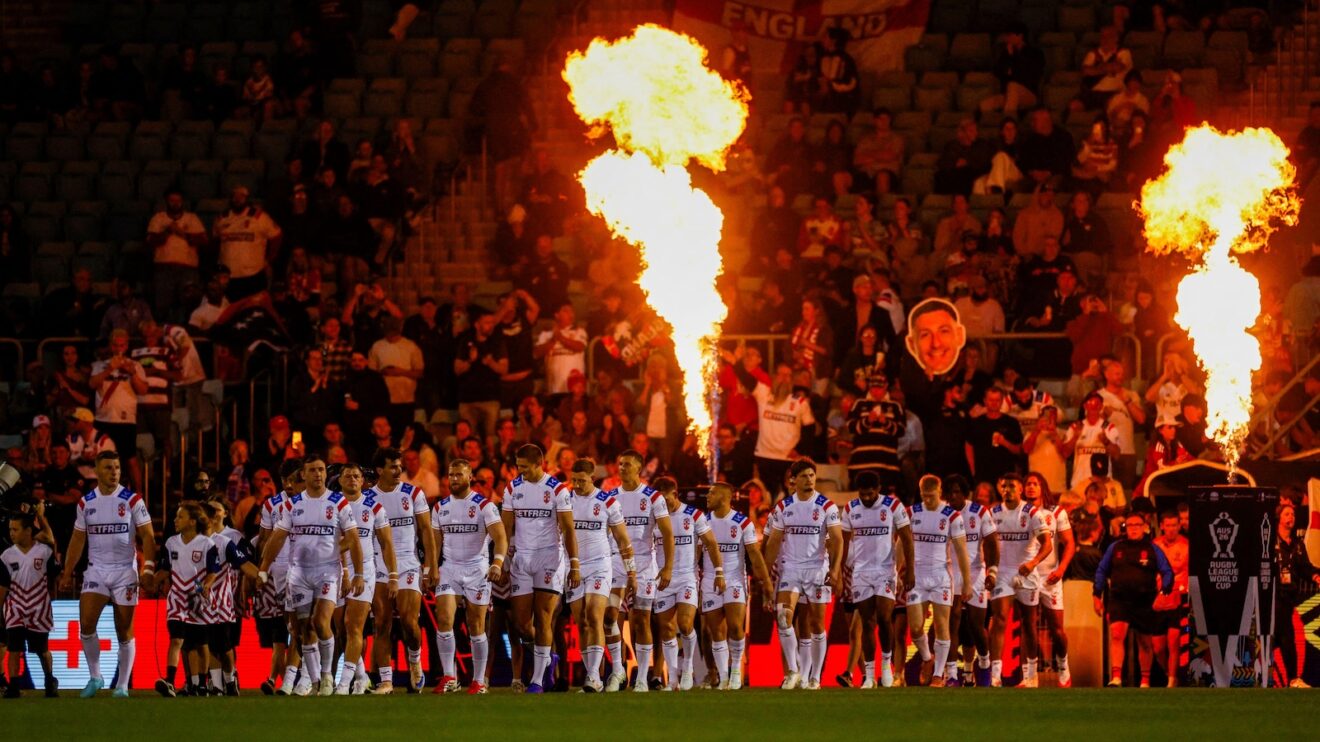
England's players in action in the 2026 Rugby League World Cup.
English rugby league finds itself at an enormous crossroads – and that is no exaggeration.
While the southern hemisphere goes into overdrive ahead of the final stages of the Rugby League World Cup – and rightly so – the mood on this side of the world is tepid to put it mildly.
The men’s team have been humbled, exiting before the semi-finals for the very first time, and rightly asking questions about how the sport has allowed the national team to drift away from the world’s elite so drastically.
Of course, there are many factors why. But it is now apparent that without real, discernible change, nothing is going to be any different in 2030 when the next World Cup rolls around. That change must start now – and it must be brave, bold and have the bigger picture in mind at all times. Club-centric behaviour must stop if England’s national team is to flourish.
Crucially, none of this can be done without money. Which is where things MIGHT be able to change if the NRL investment rolls in, gives clubs some financial breathing space and allows them to be able to tweak things. Here’s a clear, coherent plan for change..
1. The creation of a new independent commission
The easy starter for ten. The current administrators aren’t getting it right. Some of them have been around in positions for far too long. Any NRL investment must lead to a commission being formed which has key figures from both sides of the world on it that will put the greater needs of the English game, rather than any one club or competition, first.
That one is easy: and something few would disagree with.
2. A dedicated mid-season window every year
In an ideal scenario, this window – two to three weekends, perhaps – would be opened up on both sides of the world to allow the best nations to play one another on a much more regular basis. England can travel Down Under, while nations can travel to play France and then England. A Papua New Guinea, Samoa or Tonga mid-year mini-tour? Yes.
But even without that and let us assume, perhaps, that it is just Super League or the European game that decides to implement it. It can still work. England can play France. England can play the Exiles. You can even have Scotland, Ireland, France and Wales competing in a mid-season Four Nations.
More young English players can play in those games, honouring their family heritage and in time, potentially working their way into becoming England internationals. Of course, that dedicated window requires..
3. Fewer Super League games in the calendar
If investment from the NRL is coming in, ticket sales become slightly less important. Clubs either need to see the bigger picture, or a higher power needs to take it away from them.
Peter V’landys wants 24 games for his own reasons – largely to mirror the NRL calendar. But Super League should pitch the case for its own 24-game season formatted slightly differently; with a gap in the middle to allow international rugby, mid-season training camps and the England programme to have its best chance of succeeding.
4. Reduce the overseas quota from 2028
With ten quota players per club now allowed, it means that of the 238 players on show across 14 Super League teams every weekend, as many as 140 of them can be overseas. That is before you include the French players from Catalans and Toulouse, as well as the other clubs. It means that there may only be 60 or 70 English players on show in the top flight every single weekend.
Let us make no mistake about it: expanding the overseas quota to 10 was another consequence of pushing through 14 teams without proper thought. It was done to ensure there was there were enough players to fill an expanded league, but it has been done without any thought towards English rugby league’s long-term prospects.
Short-term greed, myopic thinking and another factor in why English rugby league is drifting fast. It’s already a problem; but when some of our biggest clubs like Leeds and St Helens are now using all ten quota spots, it’s a HUGE red flag.
It quite clearly needs reducing as quickly as possible if English rugby league is serious about getting its national team competitive over the next decade. Right now, we are blocking opportunities for young players. And if there isn’t the talent? Well, we’ll get to that later.
5. Implement a homegrown allocation
With no relegation for the foreseeable future, there is scope for more clubs to play their young talent, surely. A strong governance of the sport could actually enforce it by ensuring clubs make sure they have academy players in their squad every single week. The number can be debated: somewhere between 3 and 5 feels sensible.
But it automatically guarantees more and more clubs will have to develop their own pathways internally to keep up with the rules. It also means you get more opportunities to watch English talent. It’s a win-win.
6. Incentivise clubs using young English talent
Want more distribution? Feature homegrown players in your squad. If certain clubs aren’t going to do it for the bigger picture here, then they’re definitely going to do it if there is a few quid hovered under their noses.
You’d have to this a very particular way, otherwise clubs like Wigan and St Helens would get all the case. One possible option: whatever percentage of your playing time is homegrown in a given year is your benchmark. If you manage to knock it up by a set amount in 2027, you get an uptick in distribution. If it’s lower, you get less.
If you are contributing to the greater good of the game and rewarding English talent, you are rewarded in turn.
7. England’s NRL contingent play mid-season Down Under
One challenge which is likely going to remain is that England’s NRL-based players can’t make it back home mid-season for a camp, as the NRL will roll on. But that’s fine.
There are more of them there than ever before now. Could we send a smattering of our better players away for one weekend to get a mid-season game against a Papua New Guinea, for example, on an Origin week? It would be difficult, but it would at least ensure the England programme has presence on both sides of the world. And, whisper it quietly: the England head coach is already there.
8. Use the NRL money to revolutionise our pathways
English rugby league is not at a point where it can up its salary cap recklessly – so the most prudent and sensible option is to look internally at the player pool.
If clubs can afford to go to market and sign superstars, that is fantastic. But there is a real fear a large chunk of the NRL investment will be thrown into a black hole on average rugby league players from overseas. This money has to produce discernible, era-defining change. That involves a systemic overhaul of rugby league’s grassroots and pathways systems – not just a ‘review’, but a serious willingness to invest in talent development.
Invest in tomorrow as early as today, and the game can look ahead with optimism to 2030 and 2034.
9. Expose our players to more high-quality rugby
County of Origin. War of the Roses. Call it, quite simply, whatever you want. But the brutal reality is that England’s players – the ones based in England anyway – do not play enough high-octane, high-quality rugby league matches. This is yet another product of the decision to force through expansion of Super League when it wasn’t really in a position to expand, sadly.
The players of Tonga, Samoa, New Zealand and Australia now all player much higher quality rugby league on a near-weekly basis. We have some games at that level, but too many blowouts and too many games where our best English players are playing against opposition where they are not needed to be at the peak of their powers.
10. Restart the England Knights system
It still remains a mystery why it ever disappeared in the first place. While there is a lack of meaningful competition for England’s senior team on this side of the world, the Knights have a whole heap of opponents they could play including Scotland, Ireland and Wales.
It automatically expands the England programme, connects the stars of tomorrow with the stars of today and provides a genuine pathway. There is a clear gap between England Academy and the men’s senior team. The Knights is the ideal middle ground – with younger players having regular meet-ups and camps.
11. Super League reduces in size
The biggest generational question of them all – and the one some club owners probably don’t want to hear the answer to. Is Super League too big? Of course, the answer is yes.
If we want our players playing a better standard of rugby more often, if we want to put a greater focus on ensuring our best English talent has opportunity to shine, then reducing Super League back to 12 teams – at least – is the only real sensible option here. For the record, some will not want to do that, because they’ll want to prioritise club rugby first. And that’s fine: people are entitled to have that view.
But those who pushed through an expansion to 14 teams last year are also culpable for what may happen to the England national team next. If you really want a strong England, then you have to make some strong decisions. Some clubs may have to go.